


The Local SEO Checklist for Small Businesses

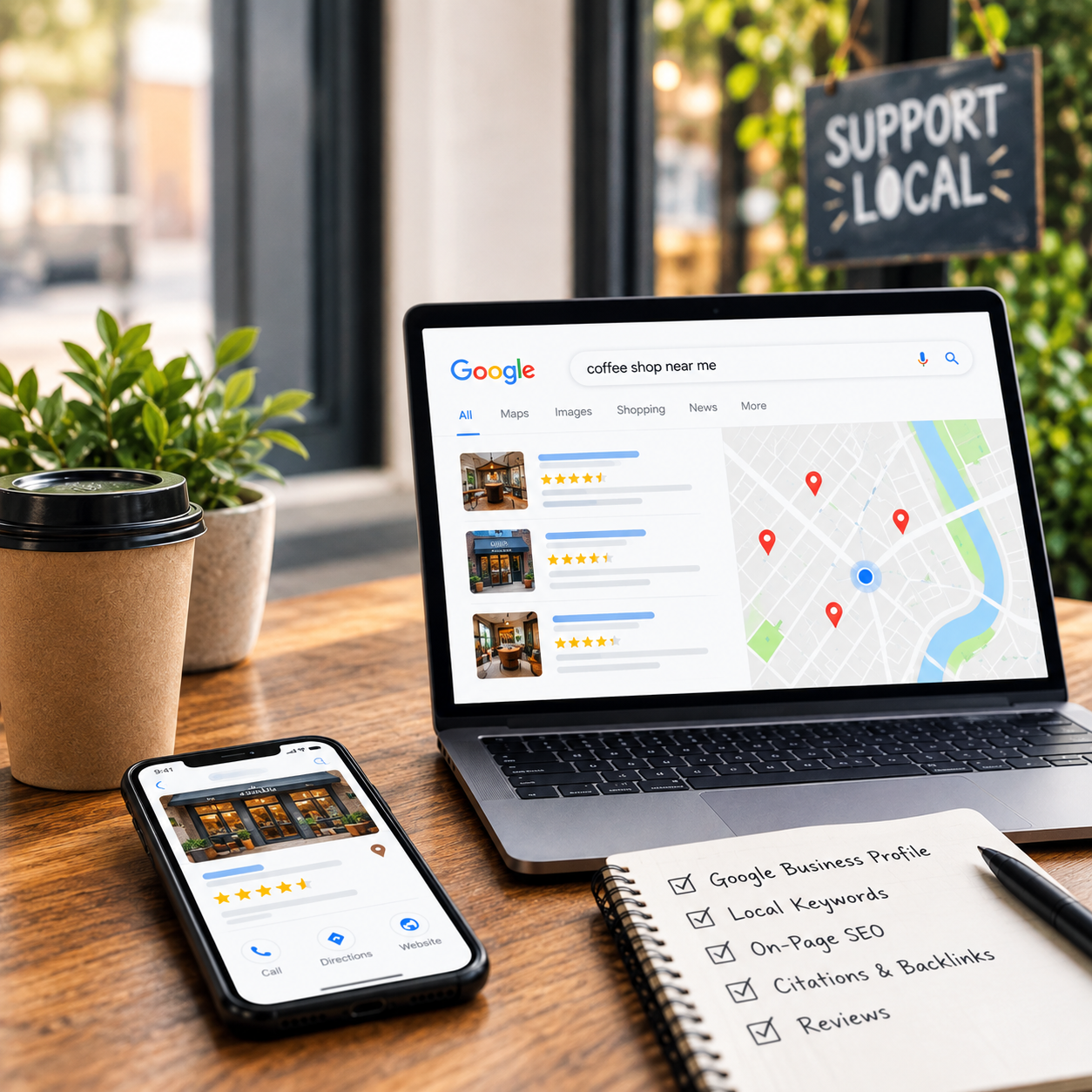
When someone searches "Custom Home Builder near me" or "best coffee in town," Google decides which local businesses show up first. Local SEO is how you earn one of those spots, and for small businesses, it's one of the most cost-effective ways to bring in customers.
The good news: you don't need a big budget or a marketing team to get started. You need the basics done right and done consistently. This local SEO checklist walks you through every step, in the order that matters most.
Short on time? Here's the checklist at a glance:
- Optimize your Google Business Profile
- Build consistent local citations
- Do on-page local SEO on your website
- Get more Google reviews
- Create local content and earn local backlinks
- Track your local SEO results
1. Optimize your Google Business Profile
Your Google Business Profile is the single biggest factor in showing up on Google Maps and in the local "map pack" (the three businesses listed under the map). For many customers, it's the first and only thing they see before they call. Treat it like a second homepage.
Google Business Profile optimization checklist:
- Claim and verify your profile
- Choose the most accurate primary category, then add relevant secondary categories
- Add your hours, including holiday hours
- List every service you offer, with short descriptions
- Set your service area if you travel to customers
- Write a clear business description that mentions what you do and where
- Upload real photos of your team, work, and location
- Post updates, offers, or news at least a few times a month
- Answer common questions in the Q&A section
Pro tip: Your primary category carries the most weight. If you're a roofer, choose "Roofing contractor," not "Contractor." Check which categories your top-ranking competitors use.
2. Build consistent local citations (NAP)
A local citation is any online mention of your business name, address, and phone number (NAP). Google cross-checks these across the web. When they match, Google trusts that your business is real and where you say it is. When they don't, your rankings can suffer.
Local citations checklist:
- Pick one exact format for your name, address, and phone number
- Use that same format on your website, Google profile, and social pages
- List your business on major directories like Bing Places, Apple Business Connect, Yelp, and Facebook
- Add industry-specific directories (Angi for home services, Healthgrades for medical, and so on)
- Find and fix old listings with outdated addresses or phone numbers
- Remove duplicate listings
Pro tip: Small details count. "Suite 200" on one site and "Ste. 200" on another can look like two different businesses. Pick one version and stick to it.
3. Do on-page local SEO on your website
Your website tells Google what you do and where you do it. The clearer you make both, the easier it is for Google to match you with local searches.
On-page local SEO checklist:
- Put your city or service area in your homepage title tag and main heading
- Create a separate page for each core service
- Create location pages if you serve multiple towns (with unique content on each, not copy-paste)
- Show your NAP in the footer of every page
- Embed a Google Map on your contact page
- Add LocalBusiness schema markup so search engines can read your details
- Make sure your site loads fast and works well on phones
- Make your phone number tap-to-call on mobile
Pro tip: A single "Services" page listing everything you do rarely ranks well. A dedicated page for each service, like "Water Heater Repair in [City]," gives Google a clear match for each search.
4. Get more Google reviews
Reviews influence both your ranking and whether people actually call you. Google looks at how many reviews you have, how recent they are, and how you respond. A steady flow of new reviews beats a big batch from years ago.
Google reviews checklist:
- Ask every happy customer for a Google review
- Make it easy with a direct review link by text or email
- Respond to every review, positive and negative
- Handle negative reviews calmly and offer to fix the issue offline
- Never buy reviews or offer rewards for them, which breaks Google's rules
Pro tip: Timing matters. Ask right after the job is done, when the customer is happiest. A quick text with your review link works better than an email a week later.
5. Create local content and earn local backlinks
Links and mentions from other local websites show Google you're an active part of your community. Local content, like blog posts about your area or projects you've done nearby, gives those sites a reason to link to you.
Local content and backlinks checklist:
- Write blog posts that answer questions local customers ask
- Share local projects, case studies, or customer stories
- Sponsor a local team, event, or charity and get listed on their site
- Join your chamber of commerce or local business groups
- Partner with nearby businesses that serve the same customers
- Pitch local news outlets and blogs when you have something worth sharing
Pro tip: You probably already have local relationships that could become links. Your suppliers, the charity you donate to, and the business association you belong to are all good places to start.
6. Track your local SEO results
You can't improve what you don't measure. Tracking shows you which efforts bring in calls and which ones need work. Check these at least once a month.
Local SEO tracking checklist:
- Review Google Business Profile insights for calls, direction requests, and website clicks
- Set up Google Search Console to see which searches bring people to your site
- Track calls and form fills in Google Analytics
- Watch your rankings for your top services in your top towns
Pro tip: Rankings on Google Maps change depending on where the searcher is standing. A local rank tracker that checks results across your service area gives you a truer picture than searching from your office.
Local SEO FAQs
How long does local SEO take to work? Most businesses start seeing movement within 3 to 6 months. Quick wins, like completing your Google Business Profile, can help sooner. Bigger gains from reviews, content, and links build over time.
Can I do local SEO myself? Yes. Everything on this checklist can be done without an agency. The challenge is consistency. Local SEO works best when reviews, posts, and content keep coming month after month.
What's the most important local SEO factor? For most small businesses, it's your Google Business Profile. A complete, active profile with strong reviews does more for map rankings than anything else.
Do I need a physical location to rank locally? No. Service-area businesses, like plumbers or cleaners who travel to customers, can rank by setting a service area in their Google Business Profile and hiding their address.
Should I run ads alongside local SEO? Many businesses do. Ads, like Local Services Ads, bring in leads right away while SEO builds long-term visibility. Together, they cover both short-term and long-term growth.
Want help checking every box?
Local SEO works best when it's done consistently, month after month. If you'd rather spend your time running your business, our team can handle it for you, from Google Business Profile optimization to reviews, citations, and tracking.
See our local SEO services and find out how we help small businesses get found by more local customers.
We won’t give your details to third party